The Real Cost of Email Spoofing
Quantify the financial impact of email impersonation and build a business case for DMARC enforcement. Includes an ROI framework.
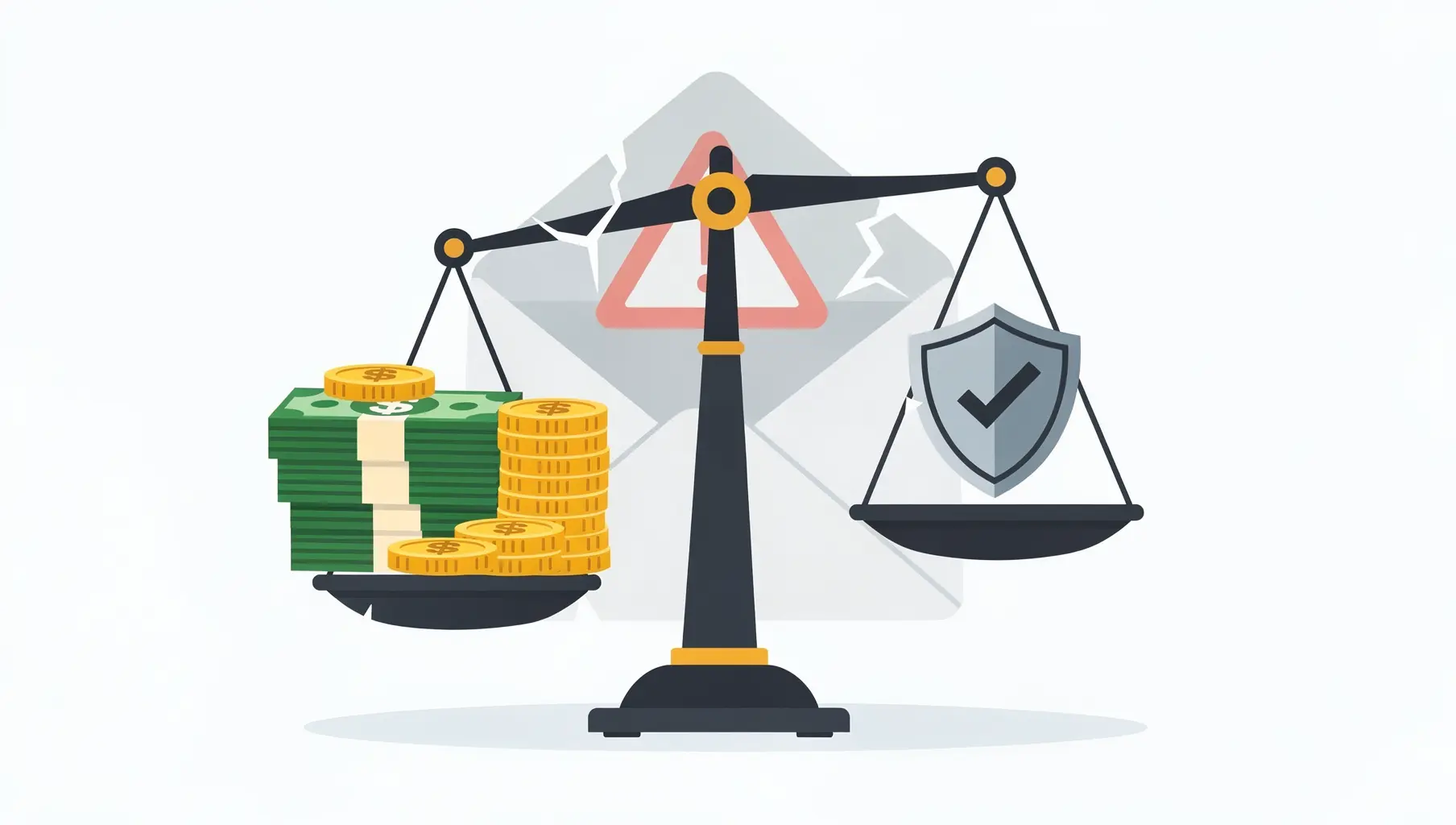
Email spoofing and business email compromise cost organizations $2.77 billion in the U.S. in 2024. But direct theft is only one piece. The true cost includes incident response, regulatory fines, lost customers, and operational disruption. This post breaks down the five categories of spoofing costs, provides a framework for calculating your own risk exposure, and shows why DMARC enforcement is one of the highest-ROI security investments you can make.
The Numbers Are Getting Worse
The FBI’s Internet Crime Complaint Center released its 2024 report in early 2025. The headline: $16.6 billion in total cybercrime losses across the United States. A 33% increase from the previous year.
Business email compromise accounted for $2.77 billion of that total across 21,442 reported incidents. BEC has been responsible for $17.1 billion in losses over the past decade, a 1,025% increase since the FBI started tracking it in 2015.
These numbers only reflect reported incidents. The FBI acknowledges that cybercrime is significantly underreported. The actual financial impact is almost certainly higher.
Phishing and spoofing led all complaint categories with 193,407 reported incidents in 2024. Losses from phishing alone jumped from $18.7 million to $70 million in a single year. A 274% increase.
These are not hypothetical risks. They are measurable, growing, and affecting organizations of every size.
The Five Costs of Email Spoofing
When most people think about the cost of email spoofing, they think about the wire transfer that went to the wrong account. But direct financial theft is only one piece of the picture.
1. Direct Financial Loss
This is the most visible cost and the one that gets the budget conversation started.
BEC attacks resulted in an average loss of $137,132 per incident in 2023, up from $74,723 in 2019. The average wire transfer request in Q4 2024 was $128,980. The FBI’s Recovery Asset Team reported a 66% success rate in freezing fraudulent transfers. That means one in three is not recovered.
Small and mid-sized businesses are targets of 70% of BEC attacks, and you do not need to be a bulk sender to be a target. The most common target is the finance department (55%), followed by executive offices (25%).
Your calculation: Look at your organization’s payment volume. How many payment requests does your finance team process each month? What is the average payment amount? If even one fraudulent request succeeds, what is the exposure?
2. Incident Response and Remediation
When an email spoofing attack succeeds, the costs extend far beyond the initial loss.
The average cost of a data breach globally reached $4.88 million in 2024. The largest contributors:
Detection and escalation costs average $1.47 million per incident. This covers forensic investigation, assessment, audit services, and crisis management.
Lost business costs average $1.38 million. System downtime, lost revenue during disruption, and customer attrition.
Post-breach response costs average $1.2 million. Credit monitoring, regulatory notifications, legal fees, and identity protection services.
For healthcare, the average breach cost was $9.8 million — see our DMARC for Healthcare guide for industry-specific implementation. Financial services was the second highest across all industries.
Your calculation: Ask your security team how many hours they spend investigating phishing and spoofing incidents each month. Multiply by the fully loaded cost per hour. Add external forensic or legal services. This is your baseline remediation spend, even without a major incident.
3. Regulatory and Compliance Penalties
The regulatory landscape for email security has shifted significantly. What was a best practice is quickly becoming a requirement.
PCI DSS 4.0 requires DMARC implementation for organizations that process payment cards, with enforcement beginning March 31, 2025.
Google and Yahoo began enforcing DMARC requirements for bulk senders in February 2024. Organizations sending more than 5,000 emails per day must have a valid DMARC record.
Microsoft followed with its own DMARC enforcement requirements for high-volume senders in 2025.
HIPAA does not name DMARC, but the Security Rule’s requirements for access controls, audit trails, and transmission security map directly to what DMARC provides. Fines for email security failures have reached $9.76 million.
NIS2 Directive requires EU entities to report significant cybersecurity incidents within 24 hours. GDPR imposes fines of up to 4% of annual global revenue for data protection failures.
Your calculation: Which regulations apply to your organization? What are the potential fines? What is the cost of an audit finding related to email security?
4. Brand and Reputation Damage
This is the hardest cost to quantify and often the most significant over time.
When an attacker spoofs your domain and sends phishing emails to your customers or partners, recipients lose trust even if they do not fall for the scam. The fact that someone could impersonate your domain raises questions about your security posture.
Nearly half of breached organizations raise prices to cover breach costs, with nearly one-third raising prices by 15% or more. Customer churn following a breach compounds over time.
For B2B organizations, brand damage affects partnerships and sales cycles directly. Prospects evaluate vendor security during procurement. A weak DMARC posture (p=none or no record) can disqualify you.
63% of organizations experienced BEC attacks in 2024. When your brand is used in one of those attacks, even if your systems were not compromised, the association sticks.
Your calculation: What is your customer lifetime value? How many customers might you lose or fail to acquire because of a spoofing incident? What is the revenue impact if a single enterprise deal falls through over a security concern?
5. Operational Disruption
Email spoofing attacks consume organizational bandwidth even when they do not result in direct financial loss.
IT and security teams investigate reported phishing attempts. Finance implements additional verification steps. Legal reviews contracts and liability. Customer service handles inbound inquiries from confused recipients.
The average time to detect a BEC attack is three weeks. During that window, the attacker may send multiple fraudulent messages or escalate access.
Without DMARC enforcement, this is a recurring cost. Every spoofing attempt requires manual investigation because there is no automated mechanism to block unauthorized use of your domain. This is one of the key reasons 95% of domains never reach enforcement.
Your calculation: How many phishing reports does your security team handle each month? How many hours per investigation? What is the opportunity cost of your security team spending time on incidents that enforcement would prevent?
Building the Business Case
You do not need a complex financial model. Here is a straightforward framework.
Calculate Your Annual Risk Exposure
Probability of a spoofing-related incident: BEC attacks accounted for 73% of all reported cyber incidents in 2024. For a mid-size organization without enforcement, 15-30% annual probability of a material incident is reasonable.
Average cost per incident: For a mid-size company, $150,000 to $500,000 conservatively. For enterprises, significantly higher.
Annual risk exposure = Probability x Average cost
Mid-size: 20% x $250,000 = $50,000 annualized risk
Enterprise: 25% x $1,000,000 = $250,000 annualized risk
Calculate Your DMARC Investment
Self-managed: Primarily internal labor. 40-80 hours over 3-6 months, plus 2-4 hours monthly for monitoring.
Managed platform: Free for monitoring, $99-499/month for full features depending on domain count.
Professional services: $5,000-$25,000 for complex environments.
Calculate Your ROI
ROI = (Annual risk reduction - Annual DMARC cost) / Annual DMARC cost
| Component | Conservative | Moderate |
|---|---|---|
| Annual risk exposure | $50,000 | $250,000 |
| Risk reduction at enforcement | 60% | 75% |
| Annual risk avoided | $30,000 | $187,500 |
| Annual DMARC platform cost | $3,600 | $6,000 |
| Net annual benefit | $26,400 | $181,500 |
| ROI | 733% | 3,025% |
These numbers do not include compliance benefits, deliverability improvements, or reduced security team workload. Each adds incremental value.
The Deliverability Bonus
DMARC enforcement does not just prevent bad things. It actively improves your email program.
Domains at enforcement see higher inbox placement rates because Google, Microsoft, and Yahoo use authentication signals in spam filtering. When your domain consistently passes DMARC, legitimate emails are more likely to reach the inbox.
For marketing teams investing in email, this translates directly to revenue. If enforcement improves inbox placement by even a few percentage points, the revenue impact is measurable and compounds over time. See 5 Key Benefits of Email Authentication for a broader look at what authentication delivers beyond security.
What the Board Wants to Hear
If you are presenting this to leadership, focus on three points:
The risk is real and growing. $2.77 billion in BEC losses in 2024. Your domain is either protected or it is not.
The investment is modest relative to exposure. A DMARC platform costs less per year than a single BEC incident costs per occurrence.
Compliance is converging on this requirement. PCI DSS 4.0, Google/Yahoo, Microsoft, and evolving regulations are all moving toward mandatory email authentication. Acting now is proactive. Acting after an incident is reactive and more expensive.
For a deeper look at what monitoring without enforcement actually costs, see The Hidden Cost of p=none.
Putting Numbers to Your Situation
Every organization’s risk profile is different. The framework above gives you a starting point, but the strongest business case uses your own data.
Pull phishing incident reports from the past 12 months. Talk to finance about payment verification processes and near-misses. Check with your email marketing team about deliverability and bounce rates. Ask security how much time they spend on spoofing investigations.
The numbers are almost always worse than leadership assumes.
Our DMARC ROI Calculator lets you input your organization’s specific data and generates a customized business case for leadership.
The Bottom Line
Email spoofing is not a theoretical risk. It is a quantifiable business problem with a proven technical solution.
DMARC enforcement does not eliminate all email threats. It does not stop compromised internal accounts or lookalike domains. But it closes one of the most significant gaps: the ability for anyone, anywhere, to send email that appears to come from your domain. Once you reach p=reject, your domain is protected.
The cost of implementing DMARC is measured in thousands per year. The cost of not implementing it is measured in hundreds of thousands to millions per incident.
The destination is enforcement. And the business case to get there writes itself.
Verkh monitors DMARC across all your sending sources and alerts you when failures appear. Download the ROI calculator spreadsheet at verkh.io/resources/reports/roi-calculator.
Related Articles

December 2025
The Hidden Cost of Staying at p=none
What weak email authentication is actually costing your business — phishing risk, brand damage, deliverability hits, and the deferred cost of staying at p=none.

May 2026
RFC 9989: The New DMARC Standard, Explained
DMARC is now an Internet Standard. RFC 9989 obsoletes RFC 7489: a DNS Tree Walk replaces the PSL, the pct tag is removed, and more. Here's what changed.
May 2026
Pacific Debt: p=none to p=quarantine in 90 Days
How Pacific Debt Relief moved from 4 years stuck at p=none to active DMARC enforcement in 90 days, and caught a live O365 spoofing attempt along the way.
Ready to implement this?
Verkh helps you monitor DMARC, identify issues, and reach enforcement. Start free.
Start Free