DMARC for Financial Services Compliance
Email authentication requirements for banks, credit unions, and fintech. How DMARC enforcement meets FFIEC, PCI DSS 4.0, and OCC expectations.
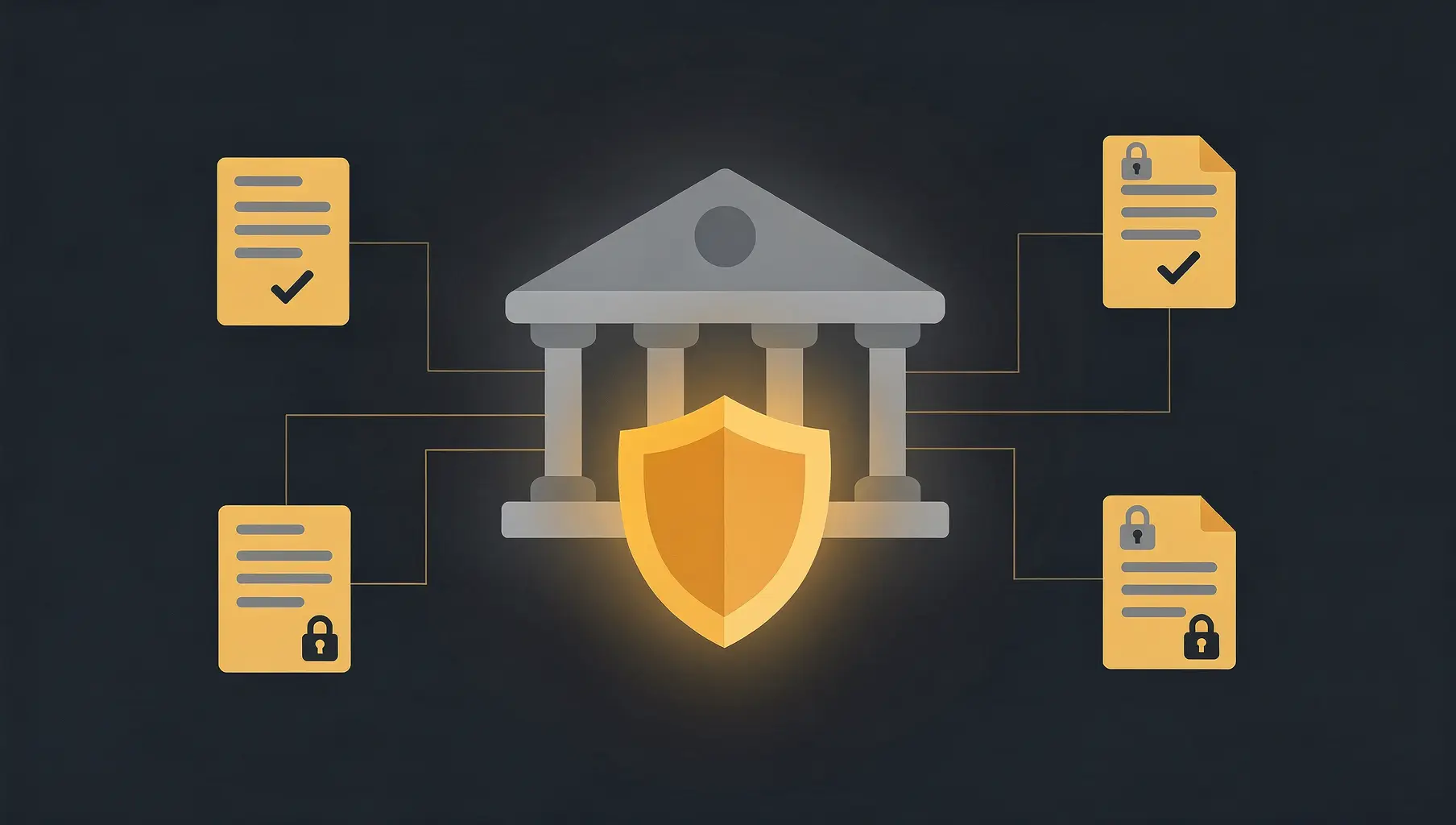
Your organization sends thousands of emails every week. Account alerts. Password resets. Wire transfer confirmations. Statements. Fraud notifications.
Your customers trust these emails because they come from you.
But attackers know this. A spoofed email that looks like it came from your bank can trick a customer into sending wire transfers, revealing account credentials, or falling for a social engineering attack. This isn’t theoretical risk—it’s happening to financial institutions right now.
The damage is real. Wire fraud losses can hit hundreds of thousands of dollars from a single email campaign. Customer trust evaporates. Regulatory agencies take notice. Your organization gets pulled into investigations.
DMARC (Domain-based Message Authentication, Reporting and Conformance) is the technical control that stops domain impersonation before it happens. It prevents attackers from spoofing your email address entirely. And regulators are starting to expect it.
Why Financial Services Is Uniquely Vulnerable
Financial services organizations face email threats that other industries don’t.
You’re a high-value target. Attackers don’t waste time spoofing the email address of a coffee shop. They go after banks, credit unions, payment processors, and fintech companies because the payoff is enormous. A single compromised wire transfer can result in six-figure losses.
Your communications carry implicit trust. When a customer receives an email from their bank, they’re primed to act on it. They click links. They enter credentials. They trust the sender. This trust is your biggest liability in an email attack because attackers exploit it relentlessly.
You have a sprawling sending infrastructure. Your organization doesn’t send email from a single system. Your core banking platform sends transactional alerts. Your CRM sends account notifications. Your marketing automation platform sends campaigns. Your payment processor sends confirmations. Your fraud detection system sends real-time warnings. Each of these systems is a potential vector for spoofing if it’s not authenticated.
You work with third-party senders. Payment processors, loan originators, customer onboarding platforms, and compliance vendors all send email on your behalf. If these vendors aren’t using authenticated sending channels, attackers can impersonate them—and by extension, impersonate you.
Your brand reputation depends on email. A single spoofed email damages customer confidence in ways that take months to recover from. Regulatory agencies notice. Customers move to competitors. Insurance premiums increase. The cost of an email spoofing attack goes far beyond the immediate financial loss.
DMARC enforcement addresses all of these vulnerabilities at once. It’s the foundational control that makes domain spoofing impossible.
The Regulatory Landscape
You’re likely hearing about DMARC from your compliance team. Here’s why they’re asking about it.
FFIEC Guidance on Email Security. The Federal Financial Institutions Examination Council (FFIEC) has issued clear expectations for email security controls. Financial institutions should implement mechanisms to authenticate outbound email and prevent unauthorized use of organizational domains. DMARC enforcement is the technical standard that satisfies this requirement.
PCI DSS 4.0 Requirement 5.4.1. The Payment Card Industry Data Security Standard now explicitly requires anti-phishing mechanisms and user awareness training. DMARC enforcement is listed as an acceptable control for preventing phishing attacks that compromise cardholder data.
OCC and FDIC Expectations. The Office of the Comptroller of the Currency and Federal Deposit Insurance Corporation both expect banking organizations to implement controls that prevent unauthorized use of institutional email addresses. Email authentication is the control framework they’re looking for.
SOC 2 Audit Requirements. If your organization undergoes SOC 2 audits (and many fintech companies do), your auditors will ask about controls that prevent unauthorized communications. DMARC enforcement is now standard practice in financial services SOC 2 compliance.
Cyber Insurance Requirements. Insurance carriers are increasingly making DMARC enforcement a condition of coverage for financial services organizations. Some policies explicitly require p=reject enforcement within a defined timeframe.
DMARC isn’t explicitly mandated in most of these frameworks. But enforcement—rejecting email that fails authentication—is the technical implementation that satisfies the intent of these requirements.
Unique Challenges for Financial Services
DMARC implementation sounds straightforward in theory. In practice, financial services organizations face obstacles that other industries don’t encounter.
Sender complexity. Your organization’s email doesn’t come from a single source. You have legacy core banking systems that send mail directly from IP addresses that are decades old. You have modern SaaS platforms sending through cloud infrastructure. You have dedicated third-party vendors managing specific customer communications. Mapping all of these senders and ensuring they’re authenticated takes time and coordination.
Change management overhead. Financial institutions operate under strict change management protocols. A DNS record change requires documentation, approval, testing, and scheduling. This isn’t bureaucracy for bureaucracy’s sake—it’s necessary governance. But it means DMARC implementation takes longer in a regulated environment.
Compliance documentation requirements. Your regulators expect evidence that you’ve implemented controls. This means detailed audit logs, sender inventories, implementation timelines, and policy documentation. You can’t just “turn on DMARC”—you need to prove you did it systematically.
Domain sprawl from mergers and acquisitions. Your organization probably owns dozens of domains. Some are actively used. Some are legacy domains from acquired companies. Some are compliance-specific domains used only for fraud alerts. Managing DMARC across a large domain portfolio requires centralized oversight.
Customer communication expectations. Your customers expect to receive emails from your organization without delays or filtering. A misconfigured DMARC policy that quarantines legitimate email damages customer experience and creates support burden.
These challenges are real. They also have solutions. The key is following a structured implementation roadmap.
Implementation Roadmap for Financial Services
Financial services DMARC implementation works best as a phased approach. Each phase builds on the previous one and reduces risk incrementally.
Phase 1: Deploy p=none and Audit Senders (2-4 weeks)
Start with a monitoring policy. Set your DMARC policy to p=none. This tells receiving mail servers not to reject email, but to send you detailed reports about what would fail authentication. You’ll get DMARC aggregate reports and forensic reports that show you exactly which senders are legitimate and which aren’t.
During this phase, work with your IT and compliance teams to build a comprehensive inventory of all systems that send email from your domain. Include:
- Core banking system email addresses
- CRM platforms
- Marketing automation systems
- Payment processors
- Fraud detection systems
- Customer communication platforms
- Compliance notification systems
This inventory is your foundation. Without it, you’ll misconfigure your authentication later.
Phase 2: Authenticate All Senders (4-8 weeks)
Configure SPF (Sender Policy Framework) and DKIM (DomainKeys Identified Mail) for every sender you identified in Phase 1. Prioritize customer-facing transactional email first—account alerts, password resets, wire transfer confirmations, statements. These are the emails customers trust most and attackers target most.
For each sender, work with the vendor or internal team to:
- Add SPF records that authorize their sending IP addresses
- Generate DKIM signing keys and configure them in their system
- Test email delivery to ensure messages arrive in the inbox
- Validate DMARC alignment (the domain in the email address matches the domain in the SPF and DKIM signatures)
This phase takes time because you’re coordinating with multiple teams and vendors. But this is where you actually implement the security.
Phase 3: Move to Quarantine with Gradual Ramping (2-4 weeks)
Once you’ve authenticated all legitimate senders, change your DMARC policy to p=quarantine with a pct value that starts low. Set pct=10, which tells receiving mail servers to quarantine only 10% of email that fails authentication. This is your safety valve.
Monitor for a week. Check your email delivery metrics. Look for complaints from customers. Increase pct gradually: 10% → 25% → 50% → 100%. Each step gives you confidence that legitimate email is still being delivered.
Phase 4: Full Enforcement at p=reject (2-4 weeks)
When pct reaches 100%, all email that fails authentication is quarantined. At this point, you have strong signal that your legitimate senders are configured correctly. Move your policy to p=reject.
p=reject tells receiving mail servers to reject email that fails authentication. The sender receives a bounce back. This is enforcement. This is what stops attackers.
Realistic Timeline: 10-20 weeks
Total implementation from Phase 1 through Phase 4 takes 10-20 weeks in a typical financial services organization. This accounts for change management overhead, vendor coordination, regulatory documentation, and testing.
This timeline is not a limitation—it’s realistic for a regulated environment. Faster implementation sacrifices the careful planning and documentation your organization needs.
Fintech-Specific Considerations
Fintech companies face different constraints than traditional banks.
Faster-moving organizations. Fintech companies typically have leaner change management processes than traditional financial institutions. This means you can move through DMARC implementation phases more quickly. But don’t let speed create gaps in documentation or compliance validation.
Complex sending infrastructure. Fintech organizations often use more third-party platforms than banks. You might send through Plaid for identity verification, Stripe for payment confirmations, customer portals for notifications, and marketing platforms for campaigns. Each of these relationships requires explicit authentication configuration.
Shared sending domains vs. dedicated domains. You might use a shared domain (like [email protected]) for multiple systems, or dedicate specific domains to specific senders. Shared domains simplify management but require careful coordination. Dedicated domains require more infrastructure but offer tighter control.
Warming schedules for new sending domains. If you launch a new product and create a new sending domain, you’ll need to warm that domain with receiving mail servers before you enforce DMARC. Sending a large volume of email immediately from a new domain can trigger spam filters. Warming means gradually increasing sending volume over weeks while you build reputation.
The implementation roadmap works the same way for fintech as it does for banks. The difference is timeline and organizational agility.
Building the Compliance Case
Your compliance and risk teams need to understand why DMARC enforcement matters. Frame it in terms they respond to.
Risk Reduction (Quantifiable). DMARC enforcement eliminates domain spoofing as an attack vector. This reduces the likelihood and impact of phishing attacks, business email compromise, and wire fraud. Quantify this: “DMARC enforcement prevents the class of attacks that resulted in X wire fraud incidents last year.”
Regulatory Compliance. Reference the specific frameworks we discussed: FFIEC guidance, PCI DSS 4.0, OCC/FDIC expectations, SOC 2 requirements. Your regulators expect email authentication controls. DMARC enforcement is how you demonstrate you have them.
Cyber Insurance Requirement. Check your cyber insurance policy. Many carriers now require DMARC enforcement. If your policy includes this requirement, enforcement becomes a business obligation, not just a security best practice.
Vendor Security Assessment Checkbox. When your organization evaluates new vendors, you ask about their security controls. Vendors increasingly ask the same question of you. DMARC enforcement is now a standard security assessment criterion.
Present to your compliance and risk committees with this narrative: “Domain spoofing is a documented threat to financial services organizations. Regulators expect us to have controls that prevent it. DMARC enforcement is the technical implementation of that control. We have a structured implementation plan that fits our change management processes. We should prioritize this.”
Conclusion: Protect Your Domain
Your domain is your brand in financial services. It’s the address your customers trust. It’s the identity attackers want to steal.
DMARC enforcement protects your domain by making it impossible for attackers to send email from your address. You move from monitoring to enforcement. You go from hoping email is authenticated to requiring it.
The implementation takes time because you operate in a regulated environment. That’s okay. Structured, documented, tested implementation is how you satisfy your regulators and protect your customers.
Your domain is too valuable to leave unprotected.
Related Articles
February 2026
DMARC for Healthcare: HIPAA Compliance
How healthcare organizations can implement DMARC while meeting HIPAA requirements. Covers the Security Rule, vendor coordination, and the path to enforcement.
January 2026
5 Key Benefits of Email Authentication
Why SPF, DKIM, and DMARC matter for security, deliverability, and brand protection. A practical guide for businesses of all sizes.

December 2025
p=none vs p=quarantine vs p=reject: Which to Use
The three DMARC policies control what happens to failing email. Learn when to use each and how to safely progress to enforcement.
Ready to implement this?
Verkh helps you monitor DMARC, identify issues, and reach enforcement. Start free.
Start Free